John McDonnell open to second Scottish independence vote
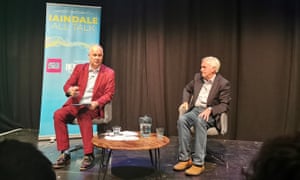
The shadow chancellor told an event at the Edinburgh festival fringe that his party should not try to block a second vote on independence by withholding the legal powers to do so.
Interviewed by the broadcaster Iain Dale, McDonnell said: “We would not block something like that. We would let the Scottish people decide. That’s democracy.”
McDonnell admitted Labour was split on the issue, but implied the UK leadership agreed. “There are other views within the party but that’s our view,” he said.
His remarks, which follow a poll on Monday showing 52% of Scottish voters now backed independence, contradict Scottish Labour policy and the formal position of the UK party not to support another independence plebiscite.
Under the current law, Holyrood could only hold one if it is given the power to do so by the UK government, under section 30 of the Scotland Act.
The Conservative government has repeatedly refused to give it such authority, but the Brexit crisis and the growing prospects of an early general election has brought this question to the fore.
Jeremy Corbyn, UK Labour leader and a close ally of McDonnell, has repeatedly wavered on the issue, but has said that if he became prime minister the party would “decide at the time” on whether to authorise a vote.
Corbyn added, however: “We don’t want another referendum, we don’t think another referendum is a good idea, and we’ll be very clear on why we don’t think it’s a good idea.”
McDonnell contradicted that stance, telling Dale: “It will be for the Scottish parliament and the Scottish people to decide that. They will take a view about whether they want another referendum. Nicola Sturgeon said by late next year or the beginning of 2021.
“The Scottish parliament will come to a considered view on that and they will submit that to the government and the English parliament itself.”
Corbyn’s Scottish advisers insist he will not do a deal with the Scottish National party by offering them a second referendum in exchange for supporting a minority Labour government at Westminster. However, the SNP are certain to put that on the table if Labour fails to win an overall majority.
McDonnell said Labour would not do any deals with other parties, including the SNP. “I think we’d form a minority government, seek to implement our manifesto and we’d expect the other opposition parties and other MPs to vote for those policies and if they don’t we’ll go back to the country.
“If they want to vote against a real living wage, if they want to vote against £70bn worth of investment in Scottish infrastructure, if they want to vote against a green industrial revolution to tackle climate change then so be it, we’ll go back to the people and then let them explain to the people why they wouldn’t support those policies.”
Recent opinion polls have shown Labour is languishing a distant third in Scotland, at less than 20%, while support for the SNP is close to 40%, suggesting Labour has been badly damaged by Corbyn’s refusal to embrace a second EU referendum and Remain.
According to those polling figures, it is highly unlikely Labour can win enough Scottish Westminster seats to command a Commons majority. Blocking a second referendum could cost Labour significant votes in Scotland, which may explain McDonnell’s new approach.
His critics argue that supporting a new referendum will hand tens of thousands of unionist votes to the Scottish Tories, who will make opposition to independence the defining issue of their general election campaign.
Since you’re here…
… we have a small favour to ask. More people are reading and supporting The Guardian’s independent, investigative journalism than ever before. And unlike many news organisations, we have chosen an approach that allows us to keep our journalism accessible to all, regardless of where they live or what they can afford. But we need your ongoing support to keep working as we do.
The Guardian will engage with the most critical issues of our time – from the escalating climate catastrophe to widespread inequality to the influence of big tech on our lives. At a time when factual information is a necessity, we believe that each of us, around the world, deserves access to accurate reporting with integrity at its heart.
Our editorial independence means we set our own agenda and voice our own opinions. Guardian journalism is free from commercial and political bias and not influenced by billionaire owners or shareholders. This means we can give a voice to those less heard, explore where others turn away, and rigorously challenge those in power.
We need your support to keep delivering quality journalism, to maintain our openness and to protect our precious independence. Every reader contribution, big or small, is so valuable.








.jpeg)
Comments
Post a Comment