Iran set to exceed uranium enrichment limit in 2015 nuclear deal
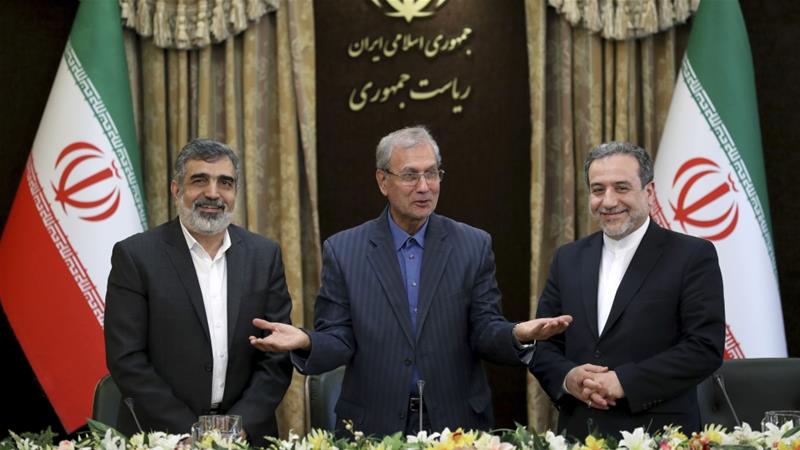
Iran has announced it will begin enriching uranium beyond the limit set in its 2015 nuclear deal with world powers "in a few hours".
The move on Sunday was part of an Iranian effort to press Europe to salvage the accord after the United States pulled out last year and reimposed punishing sanctions on Tehran, including on its oil and banking sectors.
Behrouz Kamalvandi, spokesman for Iran's atomic agency, said technical preparations for the new level of enrichment would be completed "within a few hours and enrichment over 3.67 percent will begin".
"And tomorrow early in the morning, when the IAEA [UN nuclear watchdog] takes the sample we would have gone beyond 3.67 percent," he told reporters in Tehran.
Abbas Araghchi, Iran's deputy foreign minister, said Tehran would keep reducing its commitments every 60 days unless signatories of the pact protected it from US sanctions imposed by President Donald Trump.
The landmark accord, negotiated in 2015, had offered Iran relief from global sanctions in exchange for curbs on its nuclear programme. Under the pact, Iran agreed to enrich uranium to no more than 3.67 percent, which is enough for power generation, but far below weapons-grade levels of 90 percent.
Iran denies it seeks nuclear weapons, but the nuclear deal sought to prevent that as a possibility by limiting enrichment and Tehran's stockpile of uranium to 300kg. On July 1, Iran and United Nations inspectors acknowledged Tehran had amassed more low-enriched uranium than the stockpile cap agreed under the nuclear deal.
"We are fully prepared to enrich uranium at any level and with any amount," Kamalvandi said on Sunday.
'Another step in 60 days'
Iran's President Hassan Rouhani initially flagged Tehran's intentions to reduce its commitments on May 8, exactly a year after Trump abandoned the deal.
The US leader then reimposed sanctions on Iran saying he wanted to negotiate a new deal that also addressed Tehran's ballistic missiles programme and support for armed groups in the Middle East.
The pact's remaining signatories - United Kingdom, France, Germany, Russia and China - opposed the US move, but have struggled to deliver on the economic benefits promised to Iran.
"European countries have failed to uphold their commitments and they are also responsible," Araghchi told the news conference in Tehran. "The doors of diplomacy are open but what matters are new initiatives which are required."
There was political will in Europe to save the deal, he said, referring to a new payment mechanism known as INSTEX, which is meant to help Iran bypass US sanctions. However, the trade channel was "not going to work unless European countries use it to buy Iranian oil", he said.
He added: "This is an opportunity for talks. And if our partners fail to use this opportunity they should not doubt our determination to leave the deal."








.jpeg)
Comments
Post a Comment