Iran signals ‘mass sacrifice’ in 'high stakes' Saddam-era warning amid Trump deal talks

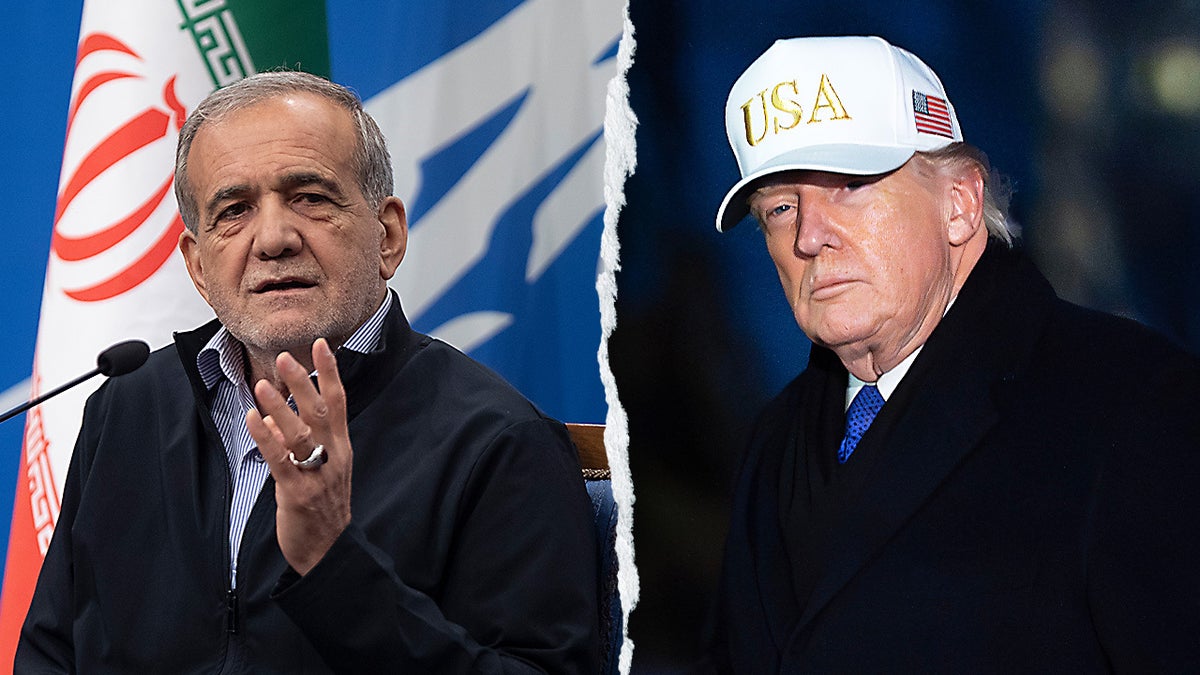
Iranian President Masoud Pezeshkian speaks with Fox News Channel's Martha MacCallum during an interview in New York City on Sept. 25, 2025. (John Lamparski/Getty Images)
President Masoud Pezeshkian invoked one of Iran’s strongest wartime symbols on May 24, signaling Tehran’s resolve to hold its ground against the U.S. and Israel across the region, a counterterrorism expert said.
The Iranian leader's remarks came at a key moment in diplomacy, as President Donald Trump said a deal with Tehran to end the war is "largely negotiated" and warned the U.S. would either sign "a great and meaningful" agreement or walk away entirely.
While Iran signaled broad agreement with Washington on some points, it said a final deal is not imminent
In an X post marking the anniversary of the 1982 recapture of Khorramshahr from Iraqi forces during the Iran-Iraq War, Pezeshkian said, "Khorramshahr today is Iran, the Persian Gulf, and the Strait of Hormuz," adding that "resistance, self-sacrifice, and repelling aggression are rooted in the culture of this land."
Analysts claimed Pezeshkian was deliberately invoking one of the deepest ideological touchstones of the Islamic Republic — the battle that came to symbolize national resistance, civilian sacrifice and defiance against invasion.
"This is the Iran-Iraq War reference, and the timing is the point," said Dr. Omar Mohammed, director of the Antisemitism Research Initiative Program on Extremism at George Washington University.
May 24 marks the anniversary of the 1982 liberation of Khorramshahr, the southwestern city Saddam Hussein captured early in the war and Iranian forces retook after months of brutal urban combat.

This is one of the Islamic Republic’s foundational mythological moments — civilian resistance, mass sacrifice, repelling an ‘aggressor army.’ Roughly what the Great Patriotic War is to Russia. The rhetorical move is the extension," Mohammed told Fox News Digital.
"He’s mapping the 1980-82 defensive-war frame onto the current confrontation: Iran attacked by an aggressor, ordinary citizens (‘battle-untested but brave’) expected to stand and fight, with ‘resistance, sacrifice, repelling aggression’ cast as the cultural default mode."
Some of the phrasing, Mohammed said, also evokes volunteer and Basij fighters versus a professional invading army. The analyst noted that Pezeshkian’s "Hormuz line" comment reflects a standard Iranian escalation tactic.
Invoking the strait inside a wartime-mobilization frame — even rhetorically — is a deliberate signal, not throat-clearing," he added.
"The Khorramshahr frame is the deepest register the regime has. It’s what they reach for to signal existential war, not a managed crisis."
Mohammed explained that Pezeshkian’s X post is framing the current confrontation from the presidential account to send a "high-stakes message."
"It’s also a tell on internal posture: Khorramshahr, in short, means ‘we are being invaded and we will not negotiate,’" he added.








.jpeg)
Comments
Post a Comment